Skip to content
GTD Infrastructure

The power lines that bring electricity to homes and businesses.

Distribution lines are what carry power the last few miles — from a substation to your neighborhood, your business, or your facility. We build new lines, replace worn-out poles, bury overhead lines underground, and install the transformers that step the voltage down to what your equipment uses. Fourteen full-time crews keep this work moving year-round.

Voltage
4 to 34.5 kV
Type
Overhead · Underground · Pad-mount
Underground methods
Trenchless drilling · Direct bury
Crews
14 full-time
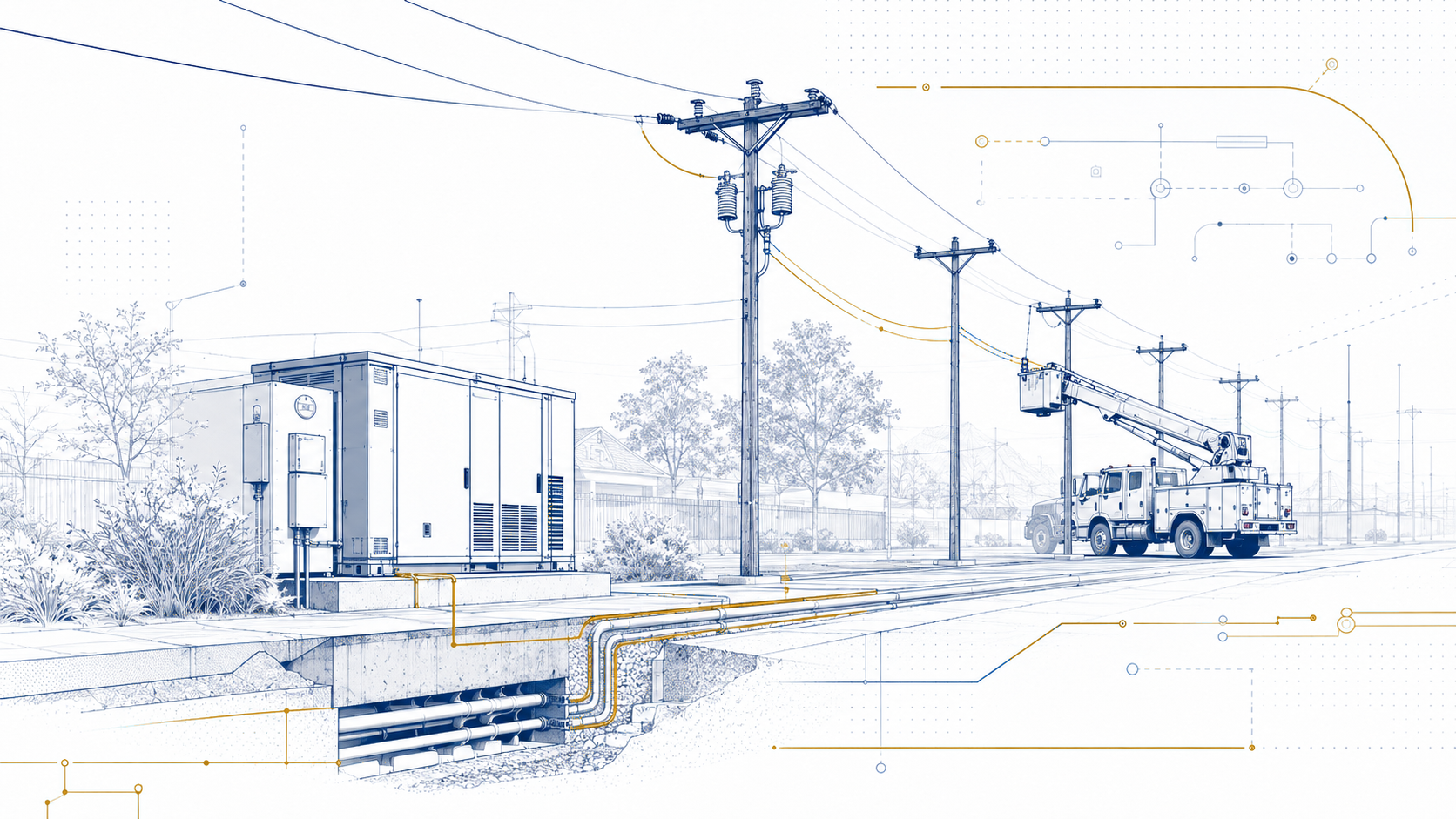
12.47 kV overhead-to-underground transition with pad-mount switchgear
FIG— 02.A  ·  12.47 KV OVERHEAD-TO-UNDERGROUND TRANSITION WITH PAD-MOUNT SWITCHGEAR

We build, strengthen, and restore the power lines that serve neighborhoods.

Overhead lines, underground lines, and everything in between — from 4,000 to 34,500 volts. Because we keep the same crews working year-round (rather than ramping up for each project), utilities can count on us to deliver hardening programs on the schedule they promise their regulators.
  • A

    New overhead lines

    We build new circuits, extend service to new neighborhoods, and add tap lines to existing systems. Both rural and urban work, with full-time crews that keep the schedule predictable.

  • B

    Underground lines

    For neighborhoods that want power lines hidden, or routes where overhead is not practical, we install lines underground. This includes drilling under highways, railroads, and wetlands without digging up the surface.

  • C

    Hardening programs

    We replace weak poles with stronger ones, convert overhead lines to underground in storm-prone areas, and add wildlife guards to prevent outages. All scheduled around the utility’s plans.

  • D

    New service connections

    When a new building or facility needs power, we set the transformer, run the cable, install the meter, and coordinate with the utility for turn-on.

How a project runs, step by step.

Every step happens inside one company — civil work, steel, electrical, and the controls that protect the system. All on the same payroll.
  1. 01

    Permits and planning

    Review property rights, coordinate with other utilities, plan traffic control, file environmental permits, and notify affected customers.

  2. 02

    Locating and trenching

    Our locate crews mark existing underground lines so we know where to dig safely. For trenchless work, our drilling rigs set up to bore under obstacles.

  3. 03

    Building the line

    Setting poles, running cross-arms, stringing overhead wire, or pulling underground cable. Installing transformers and connecting them to the system.

  4. 04

    Connecting customers

    Coordinating with the utility to switch the new line into service, installing meters, hooking up customer service, and final inspection.

Common questions.

The questions we hear most often from utility engineers, federal contracting teams, and developers.

Have a distribution project to plan?

We respond within two business days. For emergency, federal, and large industrial work, within four hours.

Start a conversation