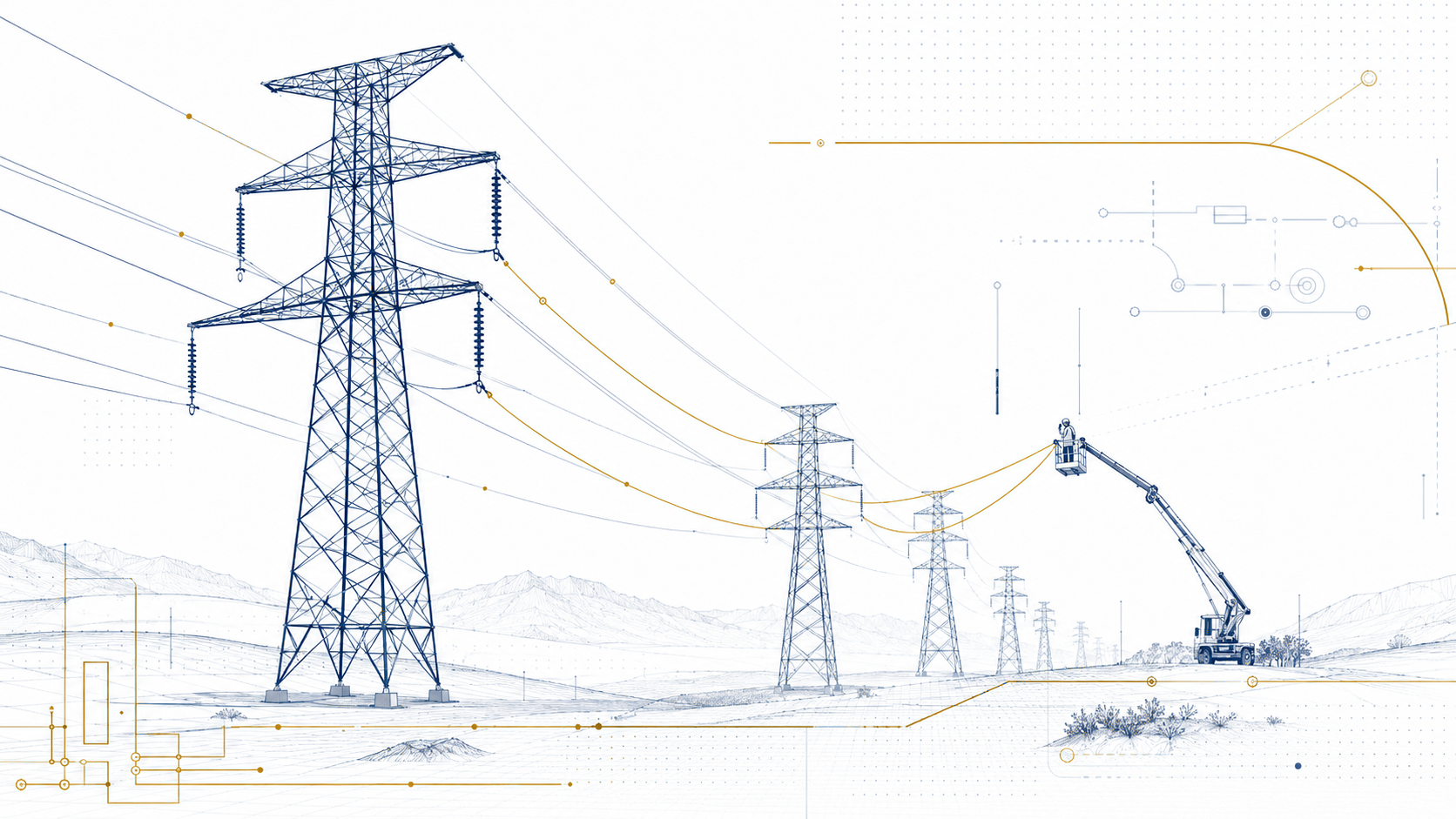
We build the high-voltage lines that carry power across the country.
Transmission lines move electricity over long distances at high voltage — anywhere from 69,000 to 500,000 volts. We build new lines, rebuild old ones, and upgrade existing corridors. Our crews can even work on lines that stay energized, so the lights stay on during the work.
- Voltage
- 69 to 500 kV
- Structures
- Lattice · Steel · Wood · Composite
- Work methods
- Energized · De-energized · Bare-hand
- Our scope
- Roads through power-on
High-voltage transmission, start to finish.
- A
New lines and rebuilds
We build new transmission corridors from scratch and replace lines that have reached the end of their life. Because we handle the access roads and grading ourselves, weather delays stay manageable.
- B
Upgrading capacity
When a utility needs to move more power on existing structures, we swap the old wire for higher-capacity conductor. Our crews can do this work on lines that stay energized, so customers keep their lights on.
- C
Storm hardening
We replace wood poles with steel, strengthen anchors, and convert weak structures so the next storm does less damage. Work is scheduled around the utility’s planned outage windows.
- D
Access roads and site work
Building a transmission line means getting equipment to remote places. We build access roads, lay matting over soft ground, and handle erosion control — all with our own crews.
How a project runs, step by step.
- 01
Plan and prepare
We survey the route, study the soil, help with environmental permits, order materials, and schedule our crews against the utility’s outage calendar.
- 02
Access roads and site work
Before any towers go up, our civil crews build the roads, lay matting where needed, and control erosion. This work stays ahead of the structure crews.
- 03
Foundations
We drill the shafts and pour the concrete that hold up every tower. Foundation work is sequenced so structures can be set on schedule.
- 04
Setting structures
Steel towers, monopoles, and wood poles go up — either by crane or, in tough terrain, by helicopter.
- 05
Pulling and tightening wire
We pull the conductor across the towers, tighten it to the right tension, and clip it into place. On lines that stay energized, we use special insulated tools.
Real projects we have built.
North Texas (ERCOT) North Texas Hyperscale Campus
- Capability
- Substation · AI
- Scale
- 345 / 138 kV · 600 MW
Kansas / Oklahoma (SPP) SPP 230 kV Reconductor — 144 miles
- Capability
- Transmission
- Scale
- 230 kV · single-circuit
CONUS Southwest DoD Forward Substation Upgrade
- Capability
- Federal · Substation
- Scale
- 69 / 12.47 kV
Common questions.
Related areas of our work.
Substation
New substations, upgrades to existing ones, and additions to live yards. From the concrete foundations through the relays that protect the system, all done by our own crews. Our team provides full-service electrical substation engineering, construction, and restoration support for new developments and repurposed industrial sites.
Read moreDistribution
New overhead and underground distribution from 4 kV to 34.5 kV. Storm hardening, pole replacement, underground conversion, and customer service connections.
Read moreEmergency Response
Storm restoration, pole replacement, line repair, and long-duration deployments.
Read moreHave a transmission project to plan?
We respond within two business days. For emergency, federal, and large industrial work, within four hours.